
Cheboygan County Court Records After Jail Arrest
The local path is arrest, booking, first court appearance, prosecutor review, and then a filed case. A person arrested by the sheriff, a city officer, state police, or another authorized agency may be booked at Cheboygan County Jail. The jail can hold the person on arrest or intake information, but the court record starts to matter once the prosecutor chooses the formal charges. Cheboygan County uses a Prosecuting Attorney, not a district attorney, and the office is led by Melissa Goodrich.
That distinction is important. A booking entry may list an arrest basis, a hold, or a first charge label, but it is not the same as a filed court case. The filed case can use different wording, add counts, reduce counts, dismiss counts, or move from District Court to Circuit Court. Custody and booking questions belong with Cheboygan County jail inmate records. Booking photo access is handled separately through Cheboygan County jail mugshots and the records-request process.
The county source chain includes the 89th District Court, the 53rd Circuit Court, the Circuit Court Records page, and the Prosecuting Attorney page. Each office serves a different role after an arrest.
Find Cheboygan County Court Records After Arrest
For most recent Cheboygan County jail arrests, District Court is the first court to check. The 89th District Court handles criminal and traffic matters, arraignments, misdemeanor cases, early felony steps, bond conditions, and related hearings. Felony cases may later move to 53rd Circuit Court. The circuit records page says circuit files are maintained by the Cheboygan County Clerk, and that the Circuit Court office itself does not keep public files in its office.
- Confirm custody or release with Cheboygan County Jail if the arrest is recent and the person may still be held.
- Search MiCOURT Case Search by name or case number, using Cheboygan court context when available.
- Read the case type, case number, CTN, hearing list, and charge entries before treating a charge as filed.
- Check 53rd Circuit Court or the County Clerk if a felony moves beyond District Court proceedings.
- Contact the court or clerk for complete files, older files, certified copies, or records that MiCOURT does not display.
MiCOURT is a public case-search portal, not a certified copy desk. It can point to case events and docket details, but certified documents and complete court files come from the office that holds the record. Michigan State Police ICHAT may be useful for public criminal-history searches, but the MSP criminal-history page states that warrant information is not available through ICHAT.
The screenshot below is from Michigan MiCOURT Case Search, the statewide portal Cheboygan court pages use for public case lookup.
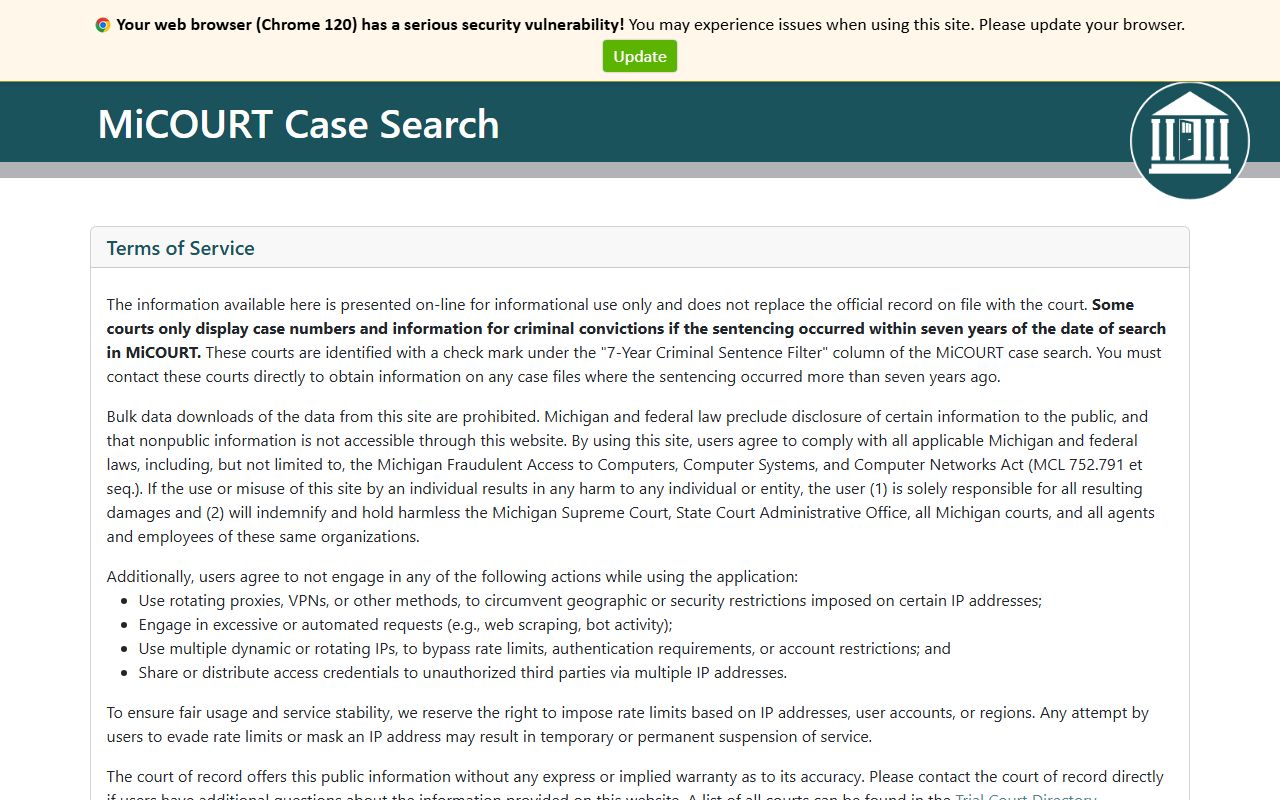
MiCOURT helps locate a case after arrest, but the court or clerk remains the source for certified copies and complete file access.
Cheboygan County MiCOURT Search Fields
MiCOURT search results depend on the fields entered and the court selected. Name spelling, date of birth prompts, court type filters, and case numbers can change the result list. The public Cheboygan Circuit Court docket display also uses CTN, which can help match a court case to a criminal-history or prosecutor reference.
| Field | How It Helps | Notes |
|---|---|---|
| Court or Location | Limits the search to the Cheboygan court context. | Use statewide search only when county routing is unclear. |
| Case Number | Finds a known file directly. | Best when a citation, clerk notice, or docket number is already known. |
| First and Last Name | Searches party names. | Try full legal names and common spelling variants. |
| Date of Birth | Helps separate people with similar names. | May be required for some criminal or traffic searches. |
| Case Type or Court Type | Filters criminal, traffic, civil, domestic, or probate records. | Available filters depend on the court and portal screen. |
| CTN | Connects court and criminal-history references. | The Cheboygan public docket display includes CTN. |
Public docket fields for the Cheboygan Circuit Court display include party name, hearing time, hearing information, case number, and CTN. A hearing entry is not a full case file. It is a pointer to a court event.
Cheboygan County Charging Documents
After a jail arrest, law enforcement reports move to prosecutor review. The prosecutor decides what charge or charges to pursue in court. In Cheboygan County, the Prosecuting Attorney page identifies Melissa Goodrich as the elected prosecutor and lists prosecutor staff for circuit and district cases. Victim-services staff may help victims with notice, hearing support, and restitution issues, but the prosecutor does not provide legal advice to defendants.
| Document | Usual Role | What to Check |
|---|---|---|
| Complaint | Starts many criminal cases and states the accusation filed in court. | Charge name, statute, offense date, bond request, and case number. |
| Information | Often used after felony bindover or filing in Circuit Court. | Final filed counts for the felony case and any amendments. |
| Indictment | A grand-jury charging document used less often in ordinary local cases. | Counts approved through the grand-jury process. |
Cheboygan court records after an arrest may also include orders, notices, bond conditions, plea entries, sentencing entries, probation terms, and dismissal orders. The label used at booking is not final proof of what the prosecutor filed.
Cheboygan County Charge Status
Charges change as a case moves. A charge may be pending at arraignment, amended after review, reduced in a plea, dismissed before trial, or resolved by plea or verdict. For Cheboygan County court records after a jail arrest, the status column or docket entry matters as much as the charge name. It tells whether the case is still active or whether the accusation has reached a court result.
| Status | Plain Meaning | Record Caution |
|---|---|---|
| Pending | The charge has been filed and remains unresolved. | It is an accusation, not a conviction. |
| Amended or Reduced | The filed charge changed by prosecutor action or court order. | Compare old and new counts before citing the case. |
| Dismissed | The court ended that charge without a conviction on that count. | Other counts in the same case may still remain. |
| Plea | The defendant entered a plea to one or more counts. | Read the final disposition before assuming sentence terms. |
| Convicted | The case resulted in guilt by plea or verdict. | Sentencing, probation, jail, or prison terms may appear later. |
Bond After Cheboygan County Arrest
Bond information may start at the jail, but formal bond orders are court records. Cheboygan County Jail can be called at (231) 627-3155 to ask whether bond has been set and whether any hold blocks release. The 89th District Court lists criminal and traffic contact information at 870 S. Main Street, P.O. Box 70, with court hours of 8:00 a.m. to 4:30 p.m. Monday through Friday, excluding holidays.
| Bond or Hold | How It Works |
|---|---|
| Cash Bond | A set amount is paid directly to secure release while the case is pending. |
| Surety Bond | A surety or bond agent posts when that method is allowed by the court. |
| Personal Recognizance | The person is released on a written promise to appear, often with conditions. |
| Conditional Bond | Release may include no contact, testing, travel limits, or treatment rules. |
| No-Bond Hold | A warrant, detainer, parole or probation hold, or court order prevents release. |
A detainer is a hold from another agency or jurisdiction. A remand order keeps a defendant in custody by court order. These terms can explain why payment on one Cheboygan County case does not always lead to release from jail.
Cheboygan County Warrants and Arrest Records
No official Cheboygan County active-warrant portal or online warrant list was located in the county and sheriff sources. The sheriff annual report does list warrant service as a sheriff call category, so warrant work is part of local law enforcement. That is not the same thing as a public warrant database.
Use phone or in-person confirmation for warrant concerns. Cheboygan County Sheriff's Office and Jail can be reached at (231) 627-3155. District Court can help with local criminal, traffic, and bench-warrant case context. MiCOURT may show failure-to-appear events, warrant-related docket entries, hearing notices, or bond changes, but it should not be treated as a full warrant clearance tool.
Note: Do not rely on Michigan ICHAT to confirm an active warrant because the MSP criminal-history page says warrant information is not available through ICHAT.
Cheboygan County Charges vs Convictions
A charge is the accusation filed in court after arrest. A conviction is the result after a guilty plea, a guilty verdict, or another qualifying court disposition. Cheboygan County court records after an arrest can show both, but they are not the same record event. Treat a pending charge as pending unless the docket shows a disposition.
| Point | Charge | Conviction |
|---|---|---|
| Stage | Accusation filed by the prosecutor. | Final guilt result by plea or verdict. |
| Proof Level | Based on probable cause and charging review. | Requires proof beyond a reasonable doubt or a valid plea. |
| Record Use | Shows what was alleged and tracked in court. | Shows the criminal-history result and may affect sentencing. |
| Can Change | May be amended, reduced, or dismissed. | May later be subject to appeal, set-aside, or other relief. |
Cheboygan County Sealed vs Expunged Records
Michigan law has separate paths for limiting public access to criminal records. MCL 28.243 addresses biometric data handling and removal or nonpublic treatment of certain arrest records after qualifying dismissals before trial. MCL 780.621 sets the application path for eligible people seeking to set aside Michigan convictions.
| Point | Sealed or Nonpublic | Set Aside or Expunged |
|---|---|---|
| Main Effect | Limits public access to the record. | Removes an eligible conviction from public view under statute. |
| Common Trigger | Dismissal, nonpublic order, juvenile status, or statutory limit. | Eligible conviction and a successful set-aside process. |
| Where to Check | Court clerk, prosecutor, or record-holding agency. | Court process under Michigan set-aside law. |
| Limits | Law-enforcement or court access may still exist. | Not every offense or record type qualifies. |
Statute note: MCL 15.231 states Michigan's broad FOIA policy, while MCL 15.235 sets the usual five-business-day response rule. FOIA still allows exemptions for records the law protects.
Restricted Cheboygan County Court Records
Some records after a Cheboygan County jail arrest may not appear in public search results. Juvenile matters, sealed cases, protected victim data, records tied to open investigations, and nonpublic filings can be withheld or limited. The sheriff police-report page also states that police reports may take 5-10 business days to complete and cannot be released until the investigation is closed.
For sheriff records, use the Cheboygan County police reports and FOIA page or the county FOIA forms page. For court files, use MiCOURT first, then contact the 89th District Court or the County Clerk for 53rd Circuit Court files. When the record is restricted, the office holding it should be asked for the reason and the available appeal or clarification path.
Record-use warning: Public lookups are not consumer reports. Do not use court, jail, or custody information for credit, employment, housing, insurance, or any other FCRA-regulated decision.